* All product/brand names, logos, and trademarks are property of their respective owners.
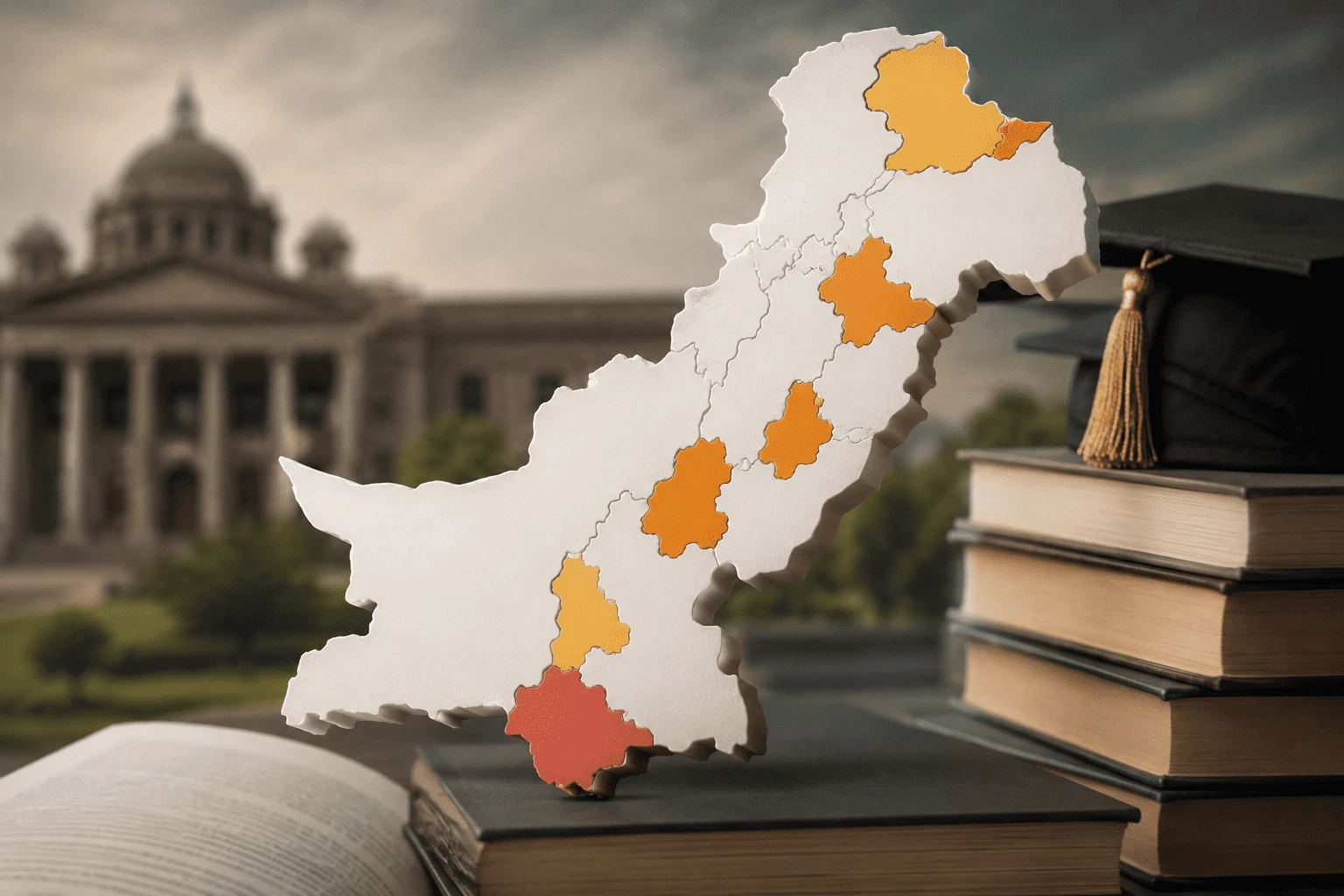
Pakistan’s latest showing in the QS World University Rankings 2027 has renewed attention on the country’s higher education divide, with a small group of institutions maintaining global visibility while many regions remain underrepresented.
According to the latest rankings, 18 Pakistani universities have been included in the global list. Quaid-i-Azam University, Islamabad, is Pakistan’s highest-ranked institution, placed at joint 381st globally. The National University of Sciences and Technology also remains among the country’s leading names in the ranking table.
The results show that Pakistan continues to have a presence in international higher education rankings, but the distribution of top-performing institutions points to an uneven academic landscape. Universities based in Islamabad, Punjab and major urban centres continue to dominate national visibility, while institutions from several other regions struggle to achieve similar global recognition.
The rankings are closely watched because they measure universities across several indicators, including academic reputation, employer reputation, faculty-student ratio, research impact, international outlook, employment outcomes and sustainability.
| No. | University Name | QS World Rank 2027 |
|---|---|---|
| 1 | Quaid-i-Azam University, Islamabad | =381 |
| 2 | National University of Sciences & Technology (NUST), Islamabad | 384 |
| 3 | Pakistan Institute of Engineering and Applied Sciences (PIEAS), Islamabad | =560 |
| 4 | University of the Punjab, Lahore | =588 |
| 5 | Lahore University of Management Sciences (LUMS), Lahore | =608 |
| 6 | University of Agriculture, Faisalabad | =629 |
| 7 | COMSATS University Islamabad | =639 |
| 8 | Government College University, Faisalabad | =691 |
| 9 | University of Engineering & Technology (UET), Lahore | 791–800 |
| 10 | Aga Khan University, Karachi | 951–1000 |
| 11 | University of Peshawar | 951–1000 |
| 12 | Bahauddin Zakariya University, Multan | 1001–1200 |
| 13 | The University of Lahore | 1001–1200 |
| 14 | Riphah International University, Islamabad | 1201–1400 |
| 15 | University of Karachi | 1201–1400 |
| 16 | University of Management and Technology (UMT), Lahore | 1201–1400 |
| 17 | International Islamic University, Islamabad | 1401+ |
| 18 | The Islamia University of Bahawalpur | 1401+ |
For Pakistan, the latest results underline a familiar challenge: access to higher education has expanded over the years, but quality, research capacity and institutional resources remain uneven. Universities in better-funded urban centres often have stronger research networks, larger faculty pools, better laboratories and more established industry connections.
Education experts have long argued that global rankings should not be treated as the only measure of university quality. However, they do provide a useful snapshot of how institutions are performing in areas that matter for international visibility, student mobility and research competitiveness.
The regional gap is especially important for students outside major cities. When universities in smaller provinces or less-developed districts lack funding, qualified faculty, research grants and modern facilities, students face fewer opportunities to compete at the national and international level.
The rankings also raise questions for policymakers. Pakistan’s higher education sector needs wider investment in faculty development, digital infrastructure, research funding, laboratories and international partnerships. Without a more balanced approach, the same cluster of institutions is likely to continue dominating global ranking tables.
A stronger regional higher education system would not only improve university rankings but also support local economies. Universities can play a key role in producing skilled graduates, supporting innovation and linking research with industry needs.
Pakistan’s inclusion of 18 universities in the QS World University Rankings 2027 shows progress in global visibility. But the broader message is clear: higher education development remains uneven, and closing regional gaps will be essential if more universities across the country are to compete internationally.
Read More
From PU to NUST: Pakistan’s Higher Education Evolution
Pakistan’s Education Evolution: From Chalkboards to AI

Hi, I’m Ahmed, a professional content writer and SEO specialist. I help businesses, brands, and websites create clear, engaging, and search-friendly content that attracts the right audience and drives results.
With a strong understanding of SEO, keyword research, blog writing, website content, and content strategy, I craft content that is not only well-written but also optimized to perform on search engines. My goal is to turn ideas into powerful words that build trust, improve visibility, and support business growth.
Whether you need blog posts, website copy, product descriptions, SEO articles, or content optimization, I can help create content that connects with readers and supports your online goals.
Pakistani students and recent graduates can now apply for the UNDP Digital, AI and Innovation Intern
7 July 2026
Lahore: The Punjab government has clarified that all tuition centres in the province are not being c
7 July 2026
The Higher Education Commission (HEC) of Pakistan has streamlined the degree attestation process by
1 July 2026
Be the first to share your thoughts
No comments yet. Be the first to comment!
Share your thoughts and join the discussion below.