* All product/brand names, logos, and trademarks are property of their respective owners.
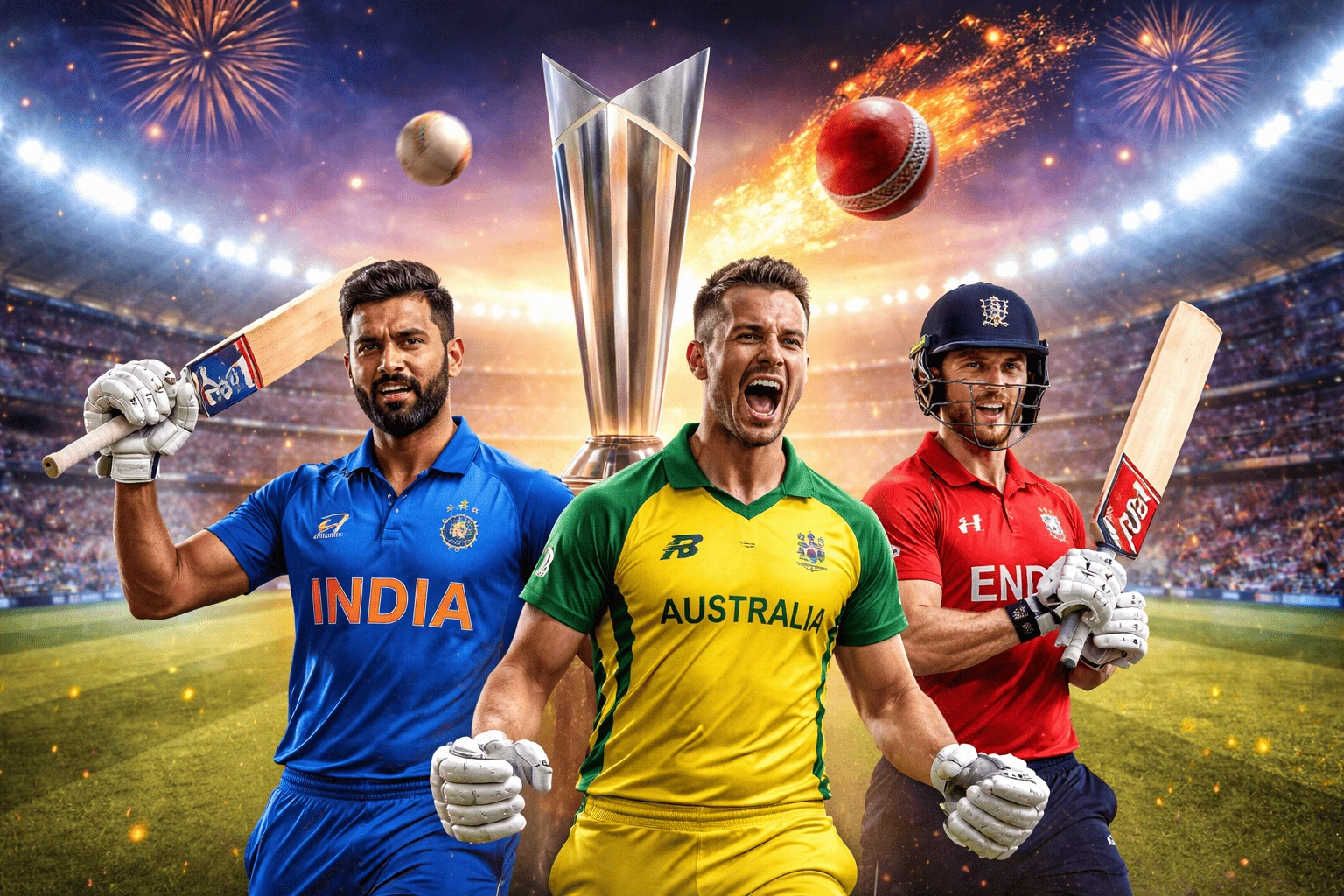
The ICC Men’s T20 World Cup 2026 has reached the stage where every match feels like a final. Co-hosted by India and Sri Lanka from 7 February to 8 March 2026, the tournament is now deep into the Super 8 phase — the part of the competition where momentum matters more than reputation.
Before the Super 8s began, most fans and experts had a familiar shortlist for the trophy: India (the defending champions), England, and a couple of other heavyweights. But T20 cricket has a special habit of flipping narratives overnight. India’s campaign took a sudden hit when they suffered a 76-run loss to South Africa in the Super 8s — their first defeat of the tournament, and the kind of loss that doesn’t just hurt points, it shakes confidence.
At the same time, the World Cup has been full of stories that make this format so addictive: rising stars announcing themselves, associate teams refusing to play like underdogs, and surprise performers stealing the spotlight from bigger names. That’s why T20 World Cup 2026 predictions feel tougher than usual — because the “safe” picks don’t look so safe anymore.
In this blog, we’ll unpack the key Super 8 picture, the teams most likely to reach the semis, the tactical trends shaping matches in India and Sri Lanka, and the stars (plus dark horses) who could decide the tournament. If you want an easy-to-follow, fan-friendly breakdown with bold but realistic calls, you’re in the right place.
The Super 8 stage is where tournament pressure becomes real. Small mistakes turn into big consequences. One collapse can wreck your net run rate, and one dominant win can change the entire group’s mood. Right now, two things stand out: South Africa and England have started strongly, and several top teams are already feeling squeezed.
Super 8 Group 1 features India, South Africa, West Indies, and Zimbabwe — and it’s already living up to the word “chaos.” South Africa’s emphatic win over India wasn’t a narrow escape; it was a statement. A 76-run victory at this stage sends a message to every dressing room: we can dominate, not just survive. The big question now is whether South Africa can keep this level and finally turn form into a deep tournament run. In past World Cups, they’ve often looked strong… until the pressure spikes. But this time feels different because they seem more balanced: reliable top-order contributions, a middle order that can accelerate, and bowlers who can defend totals.
For India, the story isn’t “they’re out” — it’s “they can’t slip again.” They still have the talent, the home familiarity, and the depth to make the semifinals. But they’ll need to bounce back fast and win key matchups. West Indies add another dangerous layer with their explosive batting, while Zimbabwe bring unpredictability — the kind of team that can destroy a favourite’s plans with one fearless performance.
My read on Group 1: South Africa looks best placed right now. India is still likely semifinal material, but only if they respond immediately and play sharper cricket in the middle overs — especially against spin.
Super 8 Group 2 includes Pakistan, Sri Lanka, England, and New Zealand, and it feels like a pressure cooker because no one gets easy games. England have begun well and look like a team built for this stage: clear roles, calm decision-making, and enough power to change games quickly.
Sri Lanka has the home advantage, which matters a lot in T20s. Familiar conditions can turn average spells into match-winning spells, and it can help batters pace their innings better. But home advantage comes with pressure too — and they’ll need to hold their nerve if a chase gets tight.
Pakistan are, as always, the hardest team to predict. That’s not a criticism — it’s their identity. They can look ordinary for 15 overs and then win the match in the final five. Their bowling gives them a chance against anyone, especially on Sri Lankan pitches where variation and control can be deadly.
New Zealand rarely look flashy, but they’re quietly dangerous. They don’t panic, they field well, and they often win the matches other teams throw away.
current semifinal prediction (based on momentum + matchups):
From Group 1: South Africa + India (India edges it if they correct quickly)
From Group 2: England + Pakistan (Pakistan edge it if bowling dominates key games)
This tournament isn’t only being decided by big names — it’s being decided by smart tactics. Conditions across India and Sri Lanka are rewarding teams that adapt quickly and punishing teams that stick to old patterns.
If there’s one repeating theme, it’s this: spin is shaping matches. On surfaces that grip and slow down even slightly, batters can’t play on autopilot. Captains are using spinners earlier, saving matchups for key batters, and treating middle overs like the real battleground. Varun Chakaravarthy has been a headline example — a mystery spinner who forces hesitation. In T20 cricket, hesitation is death. When batters can’t pick the variation, they stop attacking freely, and that’s when run rates stall.
Pakistan’s Abrar Ahmed is another key name here. He was seen by some as a “left-field” pick, but he could become a tournament-defining weapon. Sri Lankan pitches can be kind to leg-spin, and Abrar’s ability to attack rather than just contain makes him more than a defensive option. What this means for knockouts: the teams with strong spin depth — not just one good spinner — are more likely to control high-pressure games.
At the same time, the powerplay has become even more extreme. Many teams are treating the first six overs as a launchpad rather than a warm-up. The idea is simple: score fast early, then manage spin later. Abhishek Sharma represents this new wave perfectly. He doesn’t aim to “settle in.” He aims to take the match away before bowlers can settle. When he succeeds, it changes the game’s mood instantly.
Then there’s Dewald Brevis, who has started looking less like “potential” and more like a proper match-winner. His ability to attack both pace and spin makes him a rare middle-order threat — the kind of batter who can turn 120 into 170 or chase down 60 in four overs. And don’t ignore the anchor role. Pathum Nissanka has shown that anchors still matter — especially when pitches slow down or wickets fall early. His century earlier in the tournament was a reminder that smart pacing can be just as deadly as brute force.
The best T20 balance in 2026: one anchor, two fearless hitters, and a finisher who can handle pressure.
T20 World Cups always create new stars — and 2026 has produced a mix of expected heroes and shocking breakout stories.
Abhishek Sharma (India): Ultra-aggressive at the top, he’s the kind of opener who can win matches in the powerplay alone.
Varun Chakaravarthy (India): A mystery spinner who makes scoring feel risky — priceless in high-pressure games.
Pathum Nissanka (Sri Lanka): Calm, reliable, and capable of big innings when the situation demands control.
Dewald Brevis (South Africa): No longer just hype — he’s delivering as a destructive middle-order force.
These are the names that can decide the semifinals with one performance.
Zimbabwe: The tournament’s “giant-killers,” topping their group undefeated and knocking out Australia. Blessing Muzarabani has been lethal with 9 wickets in the group stage.
Shadley van Schalkwyk (USA): Even with the USA out, the 37-year-old ended the group stage as the leading wicket-taker with 13 wickets, including big spells against India and Pakistan.
Yuvraj Samra (Canada): The 19-year-old became the youngest to score a T20 World Cup century, smashing 110 vs New Zealand — a moment that screams “new era.”
These stories matter because they prove something bigger: the gap is closing. The world’s best teams can’t sleepwalk anymore.
So, who wins it? Right now, this tournament feels like it’s rewarding teams with balance, calm heads, and flexible tactics. Based on current form and how conditions are playing, my bold call is:
Predicted Final: South Africa vs England
Predicted Champion: South Africa
South Africa looks complete: confident batting, smart bowling, and momentum at the perfect time. But T20 cricket doesn’t care about predictions. One over can flip everything — a dropped catch, a two-ball cameo, a spell of mystery spin, and suddenly the “favourite” is chasing shadows. Now it’s your turn: Who are your semifinalists, and who lifts the trophy? Drop your picks — and let’s argue like real cricket fans.
Related Article
Pakistan’s Next Cricket Superstars – Rising Talents to Watch in 2026

Mushraf Baig is a content writer and digital publishing specialist focused on data-driven topics, monetization strategies, and emerging technology trends. With experience creating in-depth, research-backed articles, He helps readers understand complex subjects such as analytics, advertising platforms, and digital growth strategies in clear, practical terms.
When not writing, He explores content optimization techniques, publishing workflows, and ways to improve reader experience through structured, high-quality content.
The FIFA World Cup Round of 32 marks the start of the knockout phase in the expanded 48-team tournam
29 June 2026
Cristiano Ronaldo has made football history by becoming the first male player to score in six FIFA W
24 June 2026
ISLAMABAD: Pakistan is preparing to position itself as a major supplier of skilled labor for Saudi A
22 June 2026
Be the first to share your thoughts
No comments yet. Be the first to comment!
Share your thoughts and join the discussion below.