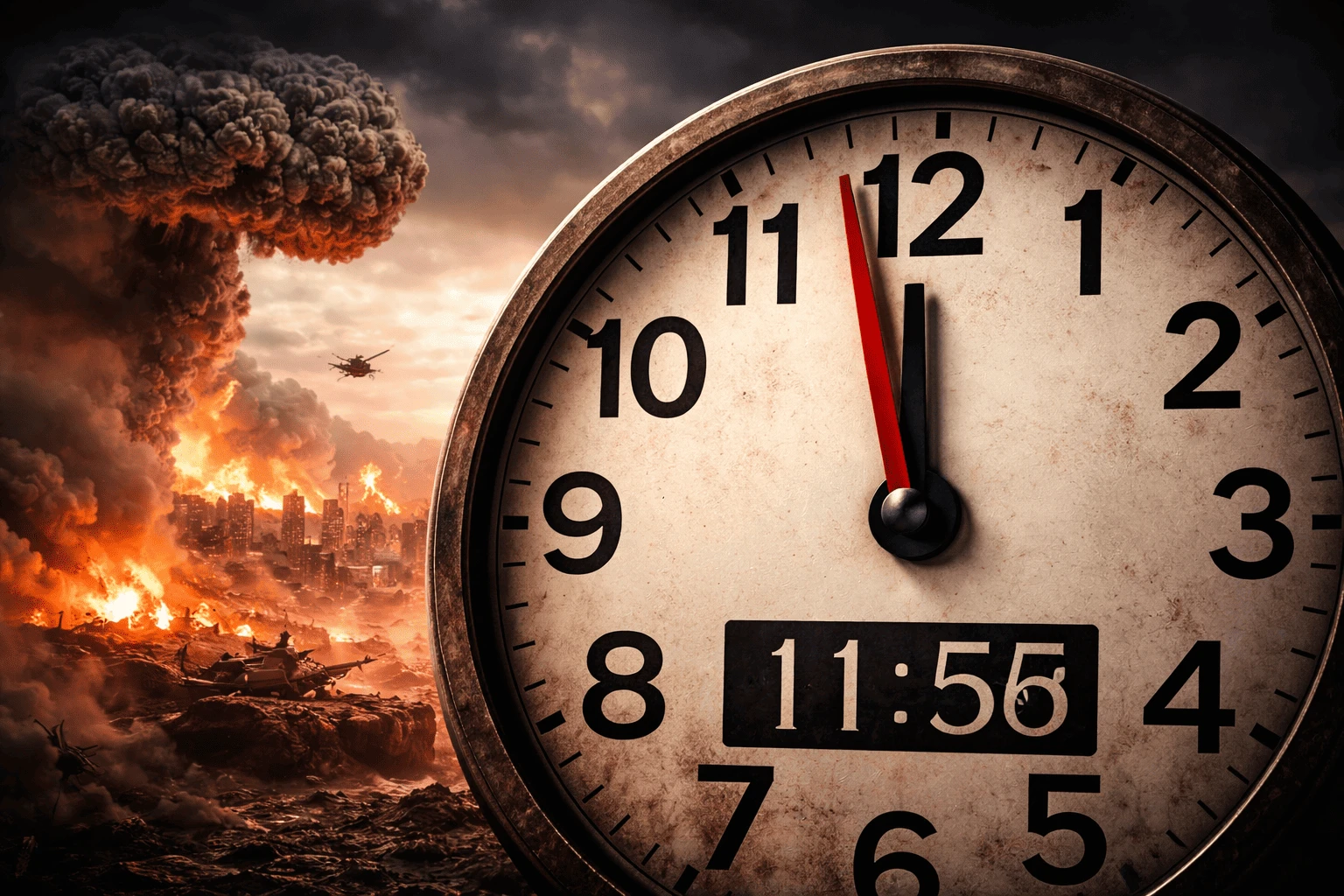
The Doomsday Clock has been moved to 85 seconds before midnight, its closest point to catastrophe in history, according to the Bulletin of the Atomic Scientists. The decision reflects growing concern over nuclear threats, the rapid development of agentic artificial intelligence (AI), and worsening global instability.
Midnight on the clock represents a man-made global disaster. The current setting signals that humanity is facing an exceptionally high level of risk, the Bulletin said. The Doomsday Clock is adjusted annually by a panel of scientists and security experts. It is designed not as a prediction, but as a warning, intended to draw attention to threats that could cause widespread harm to civilisation.
Nuclear Risks at the Forefront
The Bulletin cited the increasing danger of nuclear conflict as a primary reason for advancing the clock. Ongoing geopolitical tensions, the breakdown of arms control agreements, and the modernisation of nuclear arsenals have all contributed to a more volatile global security environment.
Experts warned that the risk of miscalculation or accidental escalation has grown, particularly as long-standing diplomatic safeguards have weakened. In several regions, strained relations between nuclear-armed states have raised fears that conflicts could spiral out of control more quickly than in the past.
The Bulletin noted that while nuclear weapons have existed for decades, current conditions have made their potential use more unpredictable. Scientists stressed that renewed efforts to reduce nuclear stockpiles and restore arms control frameworks are urgently needed.
Agentic AI Raises New Concerns
For the first time, agentic artificial intelligence played a prominent role in the decision to move the clock closer to midnight. Scientists expressed concern that increasingly autonomous AI systems are advancing faster than the laws, norms, and safety mechanisms designed to govern them.
Agentic AI refers to systems capable of making decisions and acting independently to achieve set goals. When such technologies are introduced into military planning or weapons systems, they could significantly increase the speed and scale of conflict. The Bulletin warned that poorly regulated AI could raise the risk of accidents, misuse, or rapid escalation during crises. If combined with nuclear command-and-control systems, AI-driven decision-making could reduce the time available for human judgment, increasing the chance of irreversible mistakes.
While AI offers many benefits, scientists stressed that its development must be matched by strong international oversight. At present, they said, global governance of advanced AI technologies remains inadequate.
Climate Change and Global Instability
Climate change remains a major contributor to global risk, although it was not identified as the sole driver of the clock’s movement this year. Scientists highlighted the growing impact of extreme weather events, food insecurity, and competition for resources.
These pressures, the Bulletin said, are intensifying humanitarian crises and increasing the likelihood of conflict in vulnerable regions. The effects of climate change often interact with political and economic instability, making existing tensions harder to manage. The Bulletin criticised the lack of coordinated global action on climate change, describing it as a persistent failure that worsens other existential threats.
A Warning, Not a Forecast
The Bulletin of the Atomic Scientists emphasised that the Doomsday Clock is intended as a call to action. It urged world leaders to take immediate steps to reduce nuclear dangers, strengthen international cooperation, and establish effective governance for emerging technologies such as AI.
Scientists said humanity still can move the clock away from midnight, but warned that time is running short. Achieving this, they argued, will require decisive political leadership, responsible technological development, and renewed commitment to multilateral solutions. Without such action, the Bulletin warned, the risks facing the world are likely to continue to grow.