* All product/brand names, logos, and trademarks are property of their respective owners.
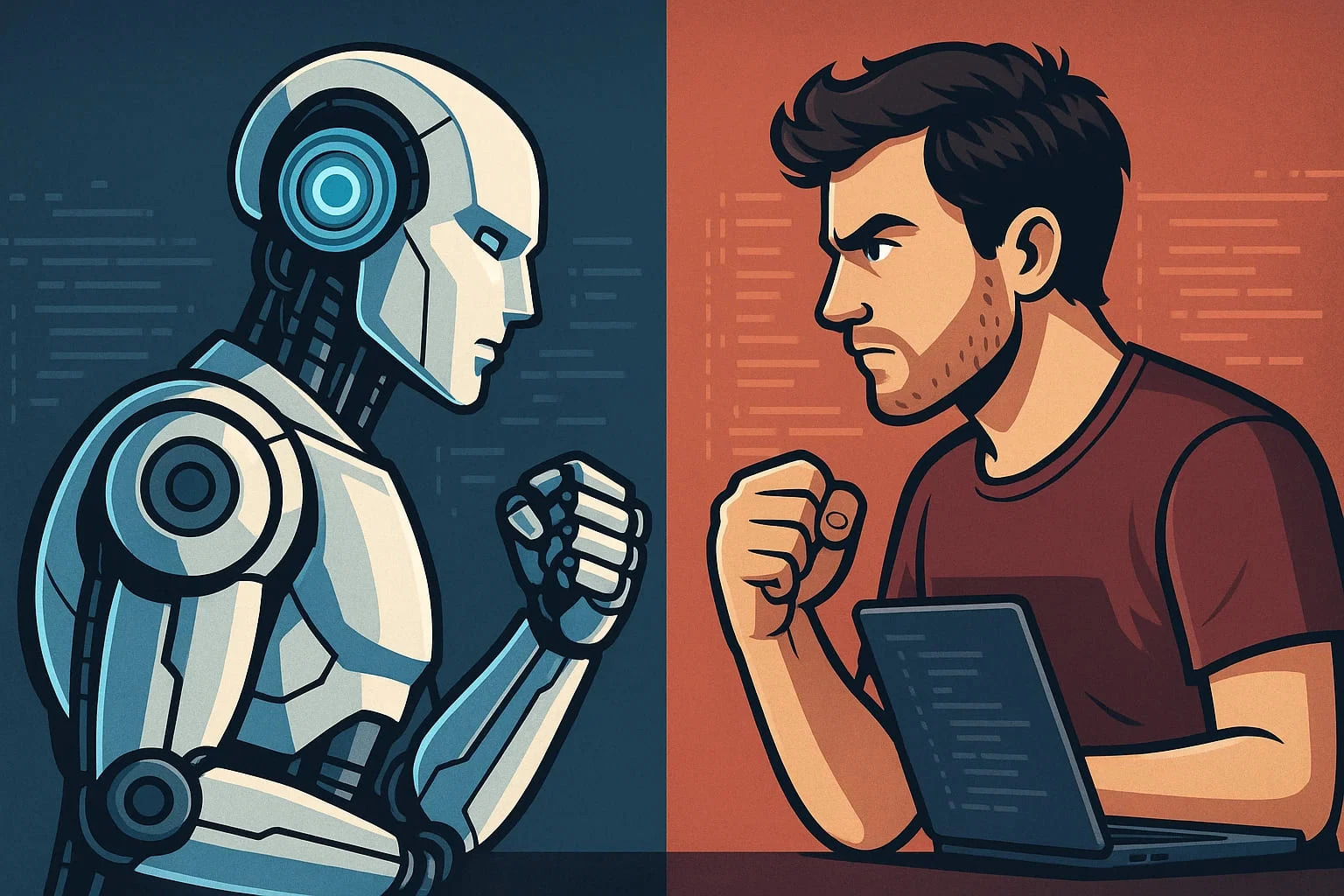
AI is everywhere — in our phones, homes, and now, in the very code that powers the digital world. What started as a tool for automating small tasks is now stepping into territory once considered untouchable: software development. For many developers, this shift is both exciting and intimidating. The question on everyone’s mind is: is AI here to help, or is it gearing up to take over?
Scroll through LinkedIn, Twitter, or developer forums, and you’ll see hot takes from every angle. Some argue that AI will make developers obsolete. Others claim it’s just another productivity tool — like Git, Stack Overflow, or JIRA — designed to streamline work and reduce repetitive tasks. Somewhere between the hype and the fear lies the real story, and that’s what we aim to uncover.
In this blog, we’ll break down the actual impact of AI on software development, focusing on how developers are using AI tools, the debates happening in online communities, and how the job landscape is evolving. We’ll also explore what this means in markets like Pakistan, where the tech sector is growing rapidly, and developers are embracing AI at a unique pace.
Whether you’re a seasoned coder, a beginner just starting your programming journey, or someone curious about the future of software, this article will provide a grounded, honest perspective on the opportunities and challenges AI brings to developers today.
AI tools like GitHub Copilot, Tabnine, and ChatGPT have gone from being experimental helpers to serious code-writing machines. At first, they were seen as productivity boosters — auto-completing code snippets, fixing bugs, or offering suggestions. But now, with advanced models capable of writing entire functions, building web apps, and even solving LeetCode problems, developers are starting to ask: Are we being replaced?
It’s not just the tools themselves — it’s the speed at which they’ve improved. What used to take developers hours, AI can now do in minutes. That doesn’t mean it’s perfect. AI often makes errors, lacks context, and can’t think creatively like a human. But for repetitive or boilerplate tasks, it’s becoming hard to beat.
Step into any dev forum, Reddit thread, or coding Discord, and you’ll hear mixed reactions.
Save time on repetitive tasks
Reduce mental fatigue
Automate documentation
Accelerate testing cycles
Entry-level jobs could diminish
Skills may degrade due to over-reliance
Developers might become too dependent on AI, limiting growth
This debate has sparked a global conversation:
If AI writes our code — are we still real developers?
The question is polarizing. Some see AI as a crutch that could weaken the craft of coding. Others view it as a powerful tool that, when used correctly, enhances productivity without compromising skill.
Ultimately, the conversation shows that AI isn’t here to eliminate developers — it’s here to reshape how they work.
It’s tempting to assume that faster coding equals better results. But speed doesn’t guarantee quality. AI-generated code still requires careful review, debugging, and contextual adjustments. Blind trust in AI can introduce security vulnerabilities, logical errors, or poorly structured solutions.
The ideal approach is a hybrid model: use AI for repetitive or time-consuming tasks, while developers focus on:
Designing system architecture
Implementing clean, maintainable logic
Solving complex problems creatively
Human judgment remains irreplaceable. AI can suggest, accelerate, and optimize, but it cannot replace intuition, empathy, or strategic thinking — all critical elements of successful software development.
So, will AI replace developers entirely? Most experts agree: not likely. AI is powerful, but it cannot replicate human creativity, critical thinking, and the ability to understand user needs. What we are witnessing is a transformation in roles rather than a replacement.
Developers are shifting from “doing everything manually” to curating and refining AI-generated code. This evolution emphasizes:
Strategic planning and decision-making
System and software design
Integrating AI tools efficiently into development workflows
Instead of fearing AI, developers are learning to leverage it as a teammate — one that handles mundane tasks while humans focus on innovation, design thinking, and problem-solving.
Thriving in an AI-driven software industry isn’t about competing with machines. It’s about learning to work alongside them effectively. Forward-thinking developers are:
Learning AI prompt engineering: Understanding how to interact with AI tools for optimal output.
Enhancing software design skills: Focusing on architecture, scalability, and maintainability.
Exploring DevOps, cloud computing, and automation: Integrating AI into modern development pipelines.
Developing soft skills: Communication, collaboration, and teamwork are increasingly valuable.
The most successful developers are not only technically proficient but also adaptable, curious, and committed to lifelong learning. In a landscape where AI can accelerate coding, the ability to design systems thoughtfully and manage AI outputs strategically becomes a distinguishing skill.
Pakistan’s tech sector is growing rapidly, making it a unique player in the global developer landscape. While global platforms are racing ahead with AI adoption, many local firms are still exploring its potential. This creates a valuable opportunity for Pakistani developers.
Local developers can:
Lead internal AI adoption strategies
Build expertise in AI tools before the market matures
Use AI to increase productivity in freelance and startup environments
Freelancers, especially, can use AI to scale client work efficiently. But to stay competitive, developers need to:
Invest in learning AI and related technologies
Stay informed on international trends
Collaborate through local tech communities and knowledge-sharing groups
Pakistan has the talent — now it needs the focus, training, and infrastructure to lead in the AI-enhanced coding era.
The rise of AI in software development is one of the most significant shifts in decades. It’s changing how code is written, how fast products are delivered, and what skills developers need to thrive. Yet despite the hype, developers are not being replaced — they are being redefined.
AI can generate code, debug, and optimize workflows. But behind every line of AI-generated code is still a human who understands context, business goals, design thinking, and user experience. AI may be fast, but human intuition, creativity, and problem-solving remain irreplaceable.
The developers who succeed in this era will be those who:
Embrace AI as a tool, not a threat
Invest in continuous learning and upskilling
Focus on strategy, design, and creativity rather than just syntax
Whether you’re coding for a startup in Karachi, freelancing online, or working at a major multinational tech firm, the future is still very much in your hands.
So here’s the question for you:
Is AI your competition, or is it your teammate?
The future of software development is still being written — and it’s up to developers to decide their role in this AI-driven world.
Also Read
The AI Revolution in Pakistan: Automate, Grow & Win in Business

An SEO specialist with a strong focus on improving website rankings and search performance.
Experienced in keyword research, on-page optimization, and content strategy.
Skilled at increasing organic traffic and enhancing online visibility.
Uses data-driven methods aligned with search engine best practices.
Committed to delivering sustainable, long-term SEO results.
Pakistan is preparing to introduce a locally developed credit card under PayPak, marking a major ste
29 June 2026
Rockstar Games has confirmed that Grand Theft Auto VI pre-orders will begin on June 25, giving playe
20 June 2026
Pakistani freelancers have emerged as a major force in the country’s digital economy, with for
20 June 2026
Be the first to share your thoughts
No comments yet. Be the first to comment!
Share your thoughts and join the discussion below.